
Is AI Making Us “Dumber”? Reclaiming Metacognition in the AI Era

In the AI era, machines can perform a vast array of tasks, often with greater speed and precision than we can. It has been said that while “AI is not smarter than humans, AI is smarter than the average human”. This shift brings us to a critical crossroad:
Is AI making us “dumber” ?
Increasingly, the answer appears to be “Yes”, especially when we fall into the trap of over-reliance. This dependence often happens so naturally that we don’t realise we are outsourcing our thinking skills.
The Science of the “AI Brain”
Recent neuroimaging research, such as the 2025 MIT study “Your Brain on ChatGPT,” has examined the cognitive debt we accumulate. The study found that users who engage a Large Language Model (LLM) before performing independent thinking show significantly less coordinated neural effort compared to those who rely on search engines or their own cognitive resources first. Furthermore, these users demonstrated a linguistic bias, mirroring specific AI vocabulary rather than developing original expressions.
As a checkpoint, our whitepaper identifies 9 Warning Signs of AI Over-reliance that suggest you may be underusing your own brain:
Copy-pasting AI output without critical evaluation.
Quoting AI as absolute truth without verification.
Outsourcing simple, everyday tasks that you are fully capable of doing.
Inability to explain the content the AI generated for you.
Difficulty producing original thoughts without an AI prompt.
Forgetting once-familiar knowledge due to lack of retrieval.
Reduced motivation to learn new, challenging skills.
Active avoidance of mentally demanding tasks.
Feeling mentally stalled or incapable when AI tools are unavailable.
Does Using AI Make You Feel Smarter Than You Actually Are?

While the classic Dunning-Kruger Effect describes a cognitive bias where individuals with low competence overestimate their own abilities, AI is fundamentally shifting this dynamic. Recent research suggests that AI creates a “supercharged” scenario where users, regardless of their actual skill level, significantly overestimate their performance.
This creates a dangerous performance-metacognition disconnect. As AI produces grammatically fluent and authoritative answers, users mistake the AI’s computational power for their own mastery. While AI improves task outcomes, it can foster an inflated sense of understanding while lacking the metacognitive awareness to realise how much they are relying on the tool versus their own foundational knowledge.
Essentially, AI masks our internal knowledge gaps. This facilitates shallow encoding, where the brain receives a polished conclusion without the rigorous mental labour of reconstructing the logic, which is the only way the brain builds long-term memory.
When you rely on GPS, you lose the ability to remember the route. When you rely on AI for conclusions, you lose the ability to build the argument.
Why does the Brain “Quits” Thinking?

According to our white paper, three primary factors fuel the AI Over-reliance Trap:
The Brain’s Drive for Efficiency
Your brain is wired to conserve energy and naturally avoids the “cognitive discomfort” of uncertainty. It seeks the path of least resistance. Cognitive offloading (using external tools to reduce mental effort) provides instant gratification, reinforcing the habit of outsourcing our thinking to AI.
The Illusion of Productivity
Modern work culture prioritises volume and rapid delivery, creating a breeding ground for over-reliance on AI. This shift happens subtly: when we choose speed over depth, we stop exercising the neural pathways required for critical thinking. Neuroplasticity is neutral. It strengthens what we use and weakens what we ignore. If you stop using your “thinking muscles”, they will inevitably atrophy.
The Illusion of Accuracy
AI systems deliver responses with a polished, authoritative tone that gives an “illusion of accuracy”. This leads to automation bias, where users overestimate AI’s reliability and stop utilising their own critical judgment, often failing to verify flawed or biased content.
Should we completely avoid using AI?
Actually, no. We aren’t necessarily becoming “dumber” because of AI, but we are becoming “cognitively fragile”. The goal is to move from being an Overreliant user to a Synergist.
To maintain your edge, you must introduce intentional friction into your workflow. Use the “Human-AI Burger” method to wrap AI usage in layers of human metacognition:
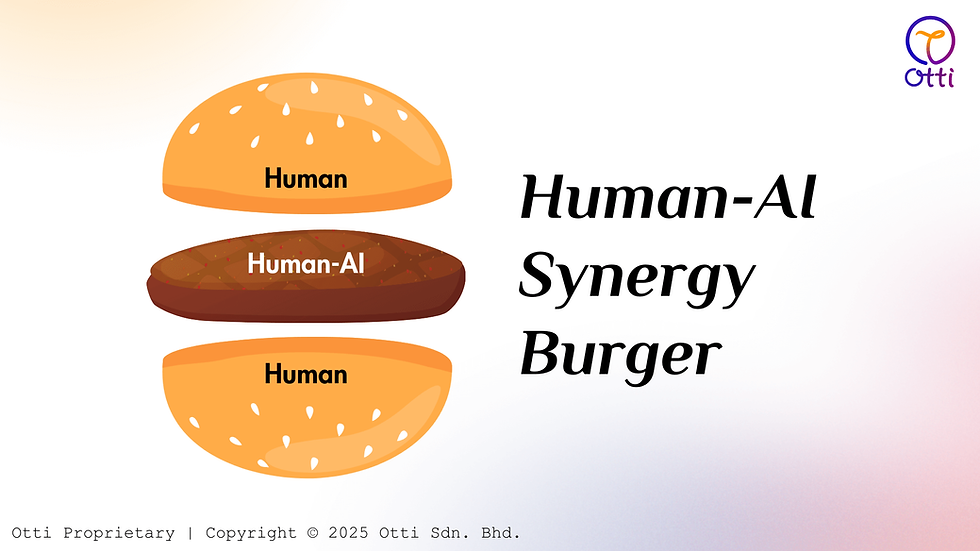
The Top Bun (Before): Set direction, imagine goals, and define values before prompting the AI. Research shows that those who think independently before using AI exert greater metacognitive effort and produce higher-quality work.
The Patty (During): Utilise AI as a collaborative tool. Rather than just asking for an answer, ask AI to challenge your assumptions, flag blindspots, or give alternative arguments. Relieve your mechanical burden by using AI for massive data processing, structured tasks, and repetitive patterns.
The Bottom Bun (After): Evaluate the output through the human lens of lived experience, ethical judgment, and cultural context—areas where AI fundamentally fails.
Reclaiming the Human Advantage
The true risk of the AI era is not that machines will outthink us, but that we will stop thinking for ourselves. AI is a powerful computational engine, but it lacks the conscious mind required to create meaning, feel empathy, or take ethical responsibility. By practising metacognition, starting from being aware of how we think, we can transform AI from a mental crutch into a strategic partner. The future belongs to those who use AI to amplify their intelligence, not replace it.

Take the test here to see if you and your team overly reliant on AI.
Master Human-AI Synergy with Otti
Don’t let your workforce become redundant through passive consumption. Foster collaboration with AI to enhance, rather than diminish, our capacity for critical thinking. Our training solutions utilise applied brain sciences and neurolearning perspectives to equip your leaders and talents to be AI-ready and future-ready. Reach out to us to learn how to use AI in a smart way.
Published on: 30 April 2026
Written by: Mandy TAN
Edited by: CHANG Yin Jue
© 2026 Centre of Applied Metacognition (CAM)


Comments