
Don't Just Ask, Guide: 10 Strategic AI Prompts for Project Managers

Are you letting AI write lazy project briefs for you?
If you are a Project Manager using AI tools like ChatGPT, Claude, or Gemini, you might have noticed a pattern: generic plans, vague risk assessments, and robotic emails. The problem is about how you incorporate your thinking while prompting AI.
At Otti, we believe in Human-AI Synergy. You don't just "ask" AI; you strategically guide it.
We have curated 10 high-value, strategic prompts specifically for Project Managers to get executive-level outputs instantly.
The Top 10 AI Prompts for Project Management
Usage Guidelines: Customise the content in the [square brackets] with specific details relevant to your situation

1. Project Planning & Strategy
Use this when initiating a complex project to ensure all milestones and resources are captured.
Prompt: |
|---|
Act as a Senior Project Manager at [insert company type, e.g., a SaaS tech company]. Goal: Create a detailed project plan for [insert project name, e.g., launching a new mobile app for inventory management]. Context & Constraints:
Output Requirements:
Tone: Professional and concise, ensuring clarity for stakeholders. Example format: Phase 1: Requirements Gathering (Weeks 1-2) - Conduct stakeholder interviews... |
2. Budget Planning & Cost Control
Use this to generate a defensive and analytical budget breakdown.
Prompt: |
|---|
Act as a Financial Manager at [insert industry, e.g., a construction firm]. Goal: Develop a comprehensive budget plan for [insert project, e.g., a new office building]. Context:
Output Requirements:
Tone: Analytical and precise, with a focus on cost efficiency. Example format: Materials: $500,000 (estimated) – Includes steel, concrete... |
3. Risk Assessment & Mitigation
Use this to proactively identify blind spots and assign accountability.
Prompt: |
|---|
Act as a Seasoned Risk Analyst tasked with optimising project resilience. Goal: Generate a detailed risk assessment and mitigation plan for [insert project description]. Current Status: [Insert status, e.g., Design phase. Concerns regarding legacy system integration and developer availability]. Output Requirements: Create a table with the following columns: Risk Description; Probability (High/Medium/Low); Impact (High/Medium/Low); Mitigation Strategy; Responsible Party Include at least 10 potential risks. Tone: Pragmatic, proactive, and solution-oriented. Model your response on this example: Risk: Integration complexity. | Prob: Medium | Impact: High | Mitigation: Early integration testing. | Owner: Lead Dev. |
4. Project Status Update (Executive Summary)
Use this to turn messy project data into a clear update for leadership.
Prompt: |
|---|
Act as a Project Director. You are required to give a high-level status update to [Senior Management / The Client]. Context - Raw Project Data: [Paste your raw notes here, including progress %, budget spend, and team updates]. Goal: Create a concise executive status report. Output Requirements:
Tone: Professional, transparent, and confident |
5. Resource Allocation & Workload Balancing
Use this to balance productivity with team well-being.
Prompt: |
|---|
Act as a Resource Manager at [insert company type]. Goal: Allocate resources for [insert project name]. Context:
Output Requirements: Create a resource allocation plan that ensures optimal utilisation while avoiding burnout. Use a Table format to show weekly assignments. Tone: Empathetic yet results-driven. Example: Week 1-2: Developers - Focus on API integration; Data Scientists - Begin training models. |
6. Agile Task Prioritisation
Use this for sprint planning and backlog management.
Prompt: |
|---|
Act as a Product Owner / Project Manager. Goal: Create a prioritised task list for the upcoming sprint based on Agile methodology. Context:
Output Requirements:
Format as a structured bulleted list with estimated completion times. Tone: Clear and organised for team alignment |
7. Strategic Negotiation & Conflict Resolution
Use this script builder to prepare for difficult conversations regarding scope, budget, or timelines.
Prompt: |
|---|
Act as a Skilled Negotiator and Project Leader. Goal: Draft a negotiation script/email for a meeting with [insert stakeholder, e.g., The Client / The Engineering Lead]. The Conflict: We are facing [insert issue, e.g., a request for 3 new features without extra budget OR a 2-week delay from the vendor]. My Desired Outcome: I need to [insert goal, e.g., protect the launch date / secure 10% more budget]. Output Requirements:
Tone: Collaborative, firm, and solution-focused. |
8. Meeting Minutes & Action Extraction
Use this to turn messy transcriptions into actionable tables.
Prompt: |
|---|
Act as a highly efficient Project Coordinator. Goal: Process the following raw meeting notes into a clean 'Post-Meeting Summary'. Input: [Paste raw meeting transcript or messy notes here]. Output Requirements:
Tone: Direct and action-oriented. |
9. Project Post-Mortem
Use this to analyse team sentiment and improve future workflows.
Prompt: |
|---|
Act as an Agile Coach facilitating a project retrospective. Goal: Analyse the feedback from the team to generate an improvement plan. Context: The team has just finished [insert project name]. Team Feedback: [Paste raw team feedback, e.g., 'Deployments were slow,' 'Communication was great,' 'Requirements kept changing']. Output Requirements: Organise the analysis into the 'Start, Stop, Continue' framework.
Tone: Constructive, psychological safety-focused, and forward-looking. |
10. Vendor or Tool Selection Matrix
Use this to make objective decisions between multiple options.
Prompt: |
|---|
Act as a Technical Project Manager and Procurement Specialist. Goal: Create a comparison matrix to select the best [insert tool/vendor type, e.g., Cloud Hosting Provider]. Context: We are comparing [Option A] vs [Option B]. Key Criteria for us: [insert criteria, e.g., Cost, Security Compliance, 24/7 Support availability, Ease of Use]. Output Requirements:
Tone: Objective and data-driven. |
Moving Beyond the Prompt
These prompts are just the beginning! To master true Human-AI Synergy, copying and pasting isn't enough. You must apply your own metacognition (higher-order thinking) to the process.
Use our Human-AI Synergy Burger Workflow™ to help you:
🍔 Before Prompting | What is the objective & outcome? |
|---|---|
🥩 During Prompting | Iterate and ask better questions. |
🍔 After Prompting | Fact-check & add authenticity. |
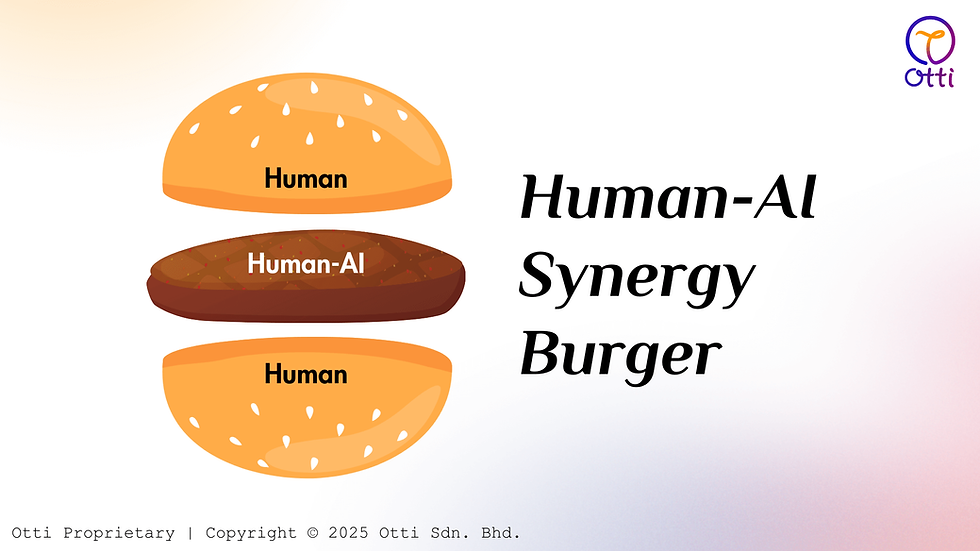
Apply this "Before, During, After" mindset to every task, and you’ll stop managing AI and start leading it.
Published on: 9 December 2025
Written by: CHANG Yin Jue
© 2025 Centre of Applied Metacognition (CAM)



Comments